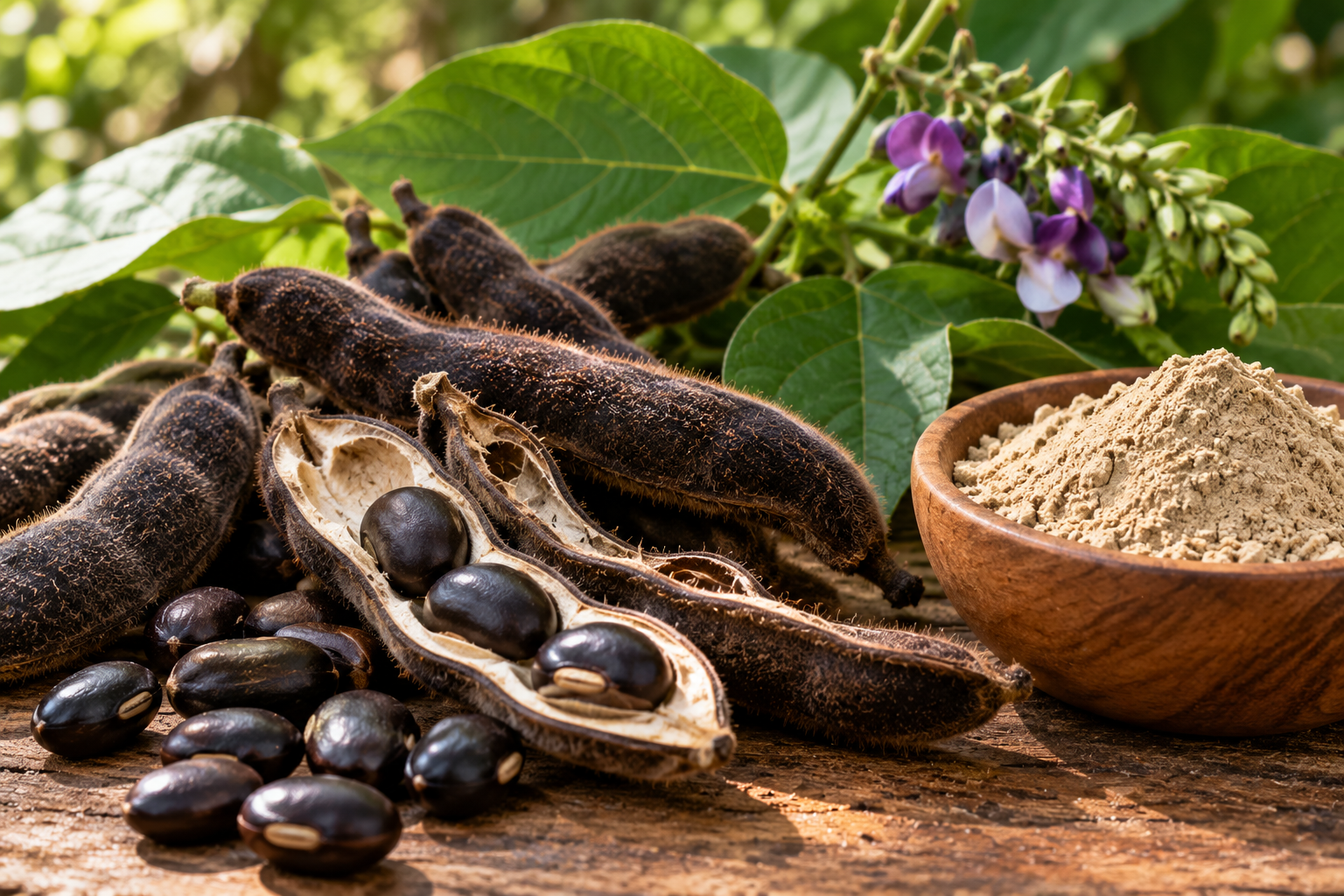
Mucuna Pruriens: Fascinating Facts About the Velvet Bean
Meet Mucuna pruriens, a tropical climbing plant with unusual seed pods, an intriguing botanical history and a rather mischievous reputation. Also known as velvet bean, this fascinating member of the legume family has attracted attention from botanists, agricultural researchers and plant enthusiasts around the world.
🌿 What Is Mucuna Pruriens?
Mucuna pruriens, commonly known as velvet bean, is a tropical climbing legume belonging to the Fabaceae family.
It grows in warm regions including India, Africa and parts of the Americas.
At first glance, it looks like another innocent member of the bean family.
But don’t let its appearance fool you.
This is not your average baked bean.
The plant is known for its vigorous climbing habit, distinctive seed pods and complex natural chemistry.
Its botanical characteristics have made it an interesting subject for research into tropical agriculture, plant cultivation and natural-product chemistry.
Some plants really do have impressive CVs.
Mucuna pruriens is a tropical climbing legume recognised for its unusual hairy pods, traditional botanical history and naturally occurring plant compounds.
🫘 Why Is It Called Velvet Bean?
You might imagine a beautifully soft, luxurious bean.
Perhaps something that belongs on a tiny botanical sofa.
Unfortunately, the reality is slightly less comfortable.
The pods of Mucuna pruriens can be covered in fine hairs that cause intense itching when they contact the skin.
The name “pruriens” is associated with itching.
In other words, the plant’s branding department clearly had a sense of humour.
The irritating hairs contain substances including mucunain, a protein associated with the itching response.
It’s a useful reminder that botanical plants can contain both fascinating compounds and substances best treated with considerable respect.
🌱 A Plant With a Long Botanical History
Mucuna pruriens has been recognised in traditional botanical literature for centuries.
In India, it is commonly known as Kapikacchu or Kaunch.
Its seeds and other plant parts have appeared in historical botanical descriptions and traditional preparation practices.
Today, researchers continue to investigate the plant’s taxonomy, chemical composition, cultivation and agricultural characteristics.
Long before modern laboratories existed, people were already observing and documenting plants such as Mucuna pruriens.
They didn’t have high-performance liquid chromatography or digital microscopes.
But they certainly knew how to keep detailed botanical traditions alive.
🔬 The Natural Chemistry of Mucuna Pruriens
One reason Mucuna pruriens has attracted scientific interest is its complex chemical composition.
Its seeds contain various naturally occurring constituents, including proteins, carbohydrates, phenolic compounds and amino acid derivatives.
Among these is L-DOPA (levodopa), a naturally occurring biochemical compound.
The concentration of individual compounds can vary depending on factors such as plant variety, growing conditions, maturity and processing.
This makes the plant an interesting subject for analytical chemistry and botanical research.
Understanding the chemical composition of plants is an important part of modern natural-products science.
And let’s face it, a plant containing a complex collection of compounds is considerably more interesting than one whose greatest achievement is looking decorative on a windowsill.
🌍 Mucuna Pruriens and Sustainable Agriculture
Mucuna pruriens isn’t just interesting because of its unusual pods and chemistry.
It also has a role in agricultural research.
As a legume, it can form relationships with nitrogen-fixing microorganisms in the soil.
Under suitable growing conditions, these relationships can contribute to soil fertility.
The plant has been investigated for use as a cover crop and green manure in tropical farming systems.
Its vigorous growth can also help provide ground cover, although careful management is important because the plant can spread rapidly.
Essentially, Mucuna pruriens is the botanical equivalent of someone who turns up to help in the garden and immediately takes over the entire project.
🌿 What Makes Velvet Bean Different From Other Legumes?
The legume family contains thousands of species, from familiar garden peas to large tropical trees.
Mucuna pruriens stands out because of its climbing growth, distinctive hairy pods and particular chemical composition.
| Feature | Mucuna Pruriens | Common Garden Pea |
|---|---|---|
| Plant family | Fabaceae | Fabaceae |
| Growth habit | Vigorous tropical climber | Annual climbing or bush plant |
| Seed pods | Often covered in irritating hairs | Generally smooth |
| Climate | Primarily tropical and subtropical | Commonly grown in temperate climates |
| Research interest | Botany, chemistry and agriculture | Food production and crop science |
Both plants belong to the same botanical family, but their characteristics and cultivation requirements differ considerably.
One produces familiar vegetables.
The other produces pods that may make you reconsider touching unfamiliar plants without gloves.
🧪 Modern Research Into Mucuna Pruriens
Modern scientific research has explored several aspects of Mucuna pruriens, including its botanical characteristics, seed composition and agricultural applications.
Researchers have investigated how cultivation conditions, plant varieties and processing methods influence its chemical profile.
Analytical techniques allow scientists to identify and measure individual compounds within botanical samples.
These methods are valuable for understanding natural variation and improving the consistency of botanical materials.
For readers interested in exploring published research, the
PubMed research database
contains scientific publications relating to Mucuna pruriens.
The botanical world is full of unanswered questions.
Fortunately, scientists seem rather fond of asking them.
🌱 Five Fascinating Facts About Mucuna Pruriens
- It’s a climber. Mucuna pruriens produces long, vigorous vines that can grow over surrounding vegetation.
- Its pods can itch. Fine hairs on the pods can cause considerable skin irritation.
- It belongs to the pea family. Despite its unusual characteristics, it shares the Fabaceae family with peas and beans.
- It has agricultural uses. The plant has been investigated as a cover crop and green manure.
- Its chemistry is complex. Researchers study its naturally occurring compounds using modern analytical techniques.
Not bad for something that initially looks like an overenthusiastic climbing bean.
❓ Frequently Asked Questions About Mucuna Pruriens
What is Mucuna pruriens?
Mucuna pruriens is a tropical climbing legume belonging to the Fabaceae family. It is commonly known as velvet bean and is recognised for its distinctive hairy seed pods.
Where does Mucuna pruriens grow?
Mucuna pruriens grows in tropical and subtropical regions, including parts of Asia, Africa and the Americas.
Why is Mucuna pruriens called velvet bean?
The name refers to the fine hairs found on its seed pods. These hairs can cause itching when they contact the skin.
What compounds are found in Mucuna pruriens?
The seeds contain a range of naturally occurring compounds, including proteins, carbohydrates, phenolic constituents and L-DOPA. Their concentrations vary between samples.
Is Mucuna pruriens related to ordinary beans?
Yes. Mucuna pruriens belongs to the Fabaceae family, which also includes peas, beans and other legumes.
What is ultrasonic botanical extraction?
Ultrasonic extraction uses high-frequency sound waves and acoustic cavitation to assist the movement of botanical compounds from plant material into an extraction liquid.
🌿 Final Thoughts: Never Underestimate a Bean
Mucuna pruriens is proof that some of nature’s most interesting plants can be found in surprisingly ordinary-looking places.
A tropical climbing vine.
A collection of rather irritating seed pods.
And a fascinating combination of botanical characteristics and naturally occurring compounds.
Who would have thought?
At Amanita Wildcraft, we believe botanical knowledge and modern scientific curiosity make an excellent combination.
Because sometimes the most interesting discoveries begin with something as simple as a bean.
Just perhaps not one you’d want to cuddle.
🌿 Discover Amanita Wildcraft
Explore our botanical collection and learn more about the plants, extraction techniques and natural compounds that make the botanical world so fascinating.
Explore Our Mucuna Pruriens Tincture →
Traditional botanicals. Modern extraction. A healthy curiosity for science.
Educational information: This article discusses botanical characteristics, plant chemistry and extraction technology. It does not provide medical advice or recommend the use of Mucuna pruriens for any health condition. The plant contains pharmacologically active constituents, and the suitability and regulatory status of finished preparations require separate assessment.